

From writing syntax to directing systems — and why the specification, not the prompt, is now the real asset.
|
Where to start Shifu Marketing helps mid-size companies turn AI-native development from a demo into an operational capability. Our 3P Model — Pain, Pilot, Proof — is how we sequence it. |
Software development used to be heavily gated. Building anything real meant engineers, architects, long specifications, sprint cycles, QA, and deployment pipelines. Even a simple idea could take months to reach a user.
Today, someone with Claude Code, Cursor, Codex, GitHub Copilot, Bolt, Lovable, or v0 can build working software in a single afternoon. That sentence would have sounded unrealistic remarkably recently. It is now ordinary.
This shift is real, and it is measurable. But most organizations are reading it wrong. They see the speed and miss the trade-off. This article explains what actually changed, where the danger is, and how Shifu Marketing sequences AI-native development for mid-size companies so that velocity becomes a durable capability rather than a liability.
The Interface Is No Longer Code — It Is Language
The old world had humans writing syntax by hand. The new world increasingly has humans describing intent while AI generates the implementation. Code is no longer the first interface. Language is.
The workflow becomes: describe, generate, run, observe, refine. Instead of fighting syntax, developers and non-developers alike focus on outcomes, workflows, UX, architecture, and business logic. The bottleneck moves upward — away from typing and toward thinking.
This is bigger than the no-code movement. No-code platforms constrained users inside predefined templates and logic blocks. Vibe coding generates systems dynamically. You describe what you want, and the system produces an implementation. The AI behaves less like a tool and more like a collaborator, a junior engineer, or an implementation engine — sometimes all at once.
Adoption Is Already Mainstream — but Trust Is Moving the Other Way
This is no longer theoretical. AI coding assistants have become standard workflow infrastructure across engineering teams.
- In Stack Overflow’s 2025 Developer Survey of more than 49,000 developers across 177 countries, 84% reported using or planning to use AI tools — up from 76% in 2024.
- JetBrains’ State of Developer Ecosystem 2025 found roughly 85% regular AI usage, with 62% relying on at least one coding assistant or agent.
- DX’s Q4 2025 impact report, analysing more than 135,000 developers, found 91% AI adoption within its sample, with about 22% of merged code AI-authored.
But here is the signal most coverage skips. In the same Stack Overflow data, trust in AI output fell to 29% — down from around 40% the year before. More developers use these tools than ever, while fewer believe what the tools produce. Adoption and trust are diverging.
That gap is the whole story. It is the difference between generating software and trusting software — and it maps directly onto the difference between a prototype and a production system.
Fast Software Is Not Automatically Good Software
AI is genuinely excellent at generating plausible code, visually impressive demos, working prototypes, and polished interfaces. But production-grade software is a different category. It requires architecture, maintainability, testing, observability, security, scalability, governance, documentation, and version control.
The current danger is not that AI cannot generate software. The danger is that organizations confuse prototype velocity with production readiness. A demo working once proves almost nothing. Production systems require repeatability, reliability, edge-case handling, and operational discipline.
|
The evidence on the gap Veracode’s 2025 GenAI Code Security Report tested more than 100 large language models across 80 coding tasks and found that 45% of AI-generated samples failed basic security tests — including an 86% failure rate on cross-site-scripting defence. Independent analysis puts AI-generated code at roughly 2.74x more vulnerabilities than human-written code. Gartner projects that 40% of AI projects will face cancellation by 2027, driven by escalating costs and weak risk controls. Google’s DORA team found that while developers estimated a 17% effectiveness gain, software delivery instability rose by nearly 10% over the same period. |
None of this argues against AI-native development. It argues that the discipline around it matters more, not less. Ironically, AI may increase the importance of engineering rigour rather than removing it.
The Real Risk Is AI-Generated Spaghetti — and the Real Fix Is the Specification
Large models are excellent at generating local solutions. But across a growing project, they can duplicate logic, create hidden dependencies, overcomplicate structures, introduce security problems, and slowly degrade maintainability — especially when a system evolves through endless unstructured prompting.
This is why the most important artifact is no longer the prompt, and not even the code. It is the specification. The organizations moving fastest with AI-native development treat requirements, workflows, data contracts, governance rules, and architecture decisions as the real system foundation. The AI becomes the implementation layer underneath a human-owned specification.
A Worked Example: An SHK Network Service Provider
Consider a real pattern from our consulting work. A service provider supporting a network of roughly 50 SHK trade businesses (heating, ventilation, and plumbing contractors) needed a sales tool. Its member contractors were losing deals in the customer’s living room: a heat-pump quote of around €30,000 lands badly when the contractor has no live calculation on hand — no tool that computes current state, renovation options, government funding, and amortisation in 90 seconds. The existing aid was a static PDF. The result was lost or stalled deals.
This maps cleanly onto the 3P Model we use to sequence every AI-native build.
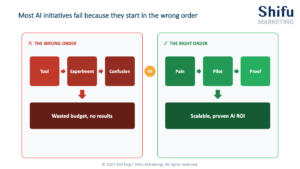
Pain: name the problem before touching a tool
The Pain was specific and quantifiable: contractors could not show a credible savings calculation on a tablet during a live consultation. Funding logic for 2026 — across the German BAFA, KfW, and BEG programmes — had become too complex for any advisor to hold in their head. The problem definition came first. No prompt was written until the Pain was written down.
Pilot: a working prototype, validated against a built-in market
The Pilot was a working configurator: a tablet-friendly web app where a customer and the contractor enters critical data around the current system (floor area, current heating system, age, renovation status), selects a target system, and sees first-year savings, investment, funding, net cost, amortisation, and CO₂ reduction recalculated in under 500 milliseconds. Crucially, the pilot had a built-in beta market — the network’s existing member businesses, who would use the tool immediately. AI-native tooling made this prototype fast to build. That speed is exactly what vibe coding delivers.
Proof: hardening the prototype into a production system
Proof is where prototype velocity meets production discipline — and where the specification did its work. A 10-section product requirements document defined the system before scale: functional requirements for the calculation engine and funding logic, explicit non-goals (no multi-tenant SaaS, no end-customer login, no accounting integration in version one), a data model, acceptance criteria, and a risk register.
The production stack was chosen deliberately, not generated ad hoc: a Next.js front end, Supabase for authentication and a PostgreSQL database, and hosting — all in an EU region for GDPR compliance, with data-processing agreements documented for every external provider. Co-branding was solved as per-login UI theming rather than separate infrastructure per business, a specification decision that removed an estimated 80-plus hours of multi-tenant complexity. Funding rates and cost assumptions were placed in an admin-editable configuration database so the logic survives the dynamic changes in particular on government programmes without a code deployment.
That last point is the article’s thesis in miniature. The AI can generate the configurator in an afternoon. Only a human specification decides that funding rates must be data, not code — because a human understood that BAFA changes its rates and the system must not break when it does. The prototype proves the idea. The specification makes it survivable.
Product Managers Are Becoming Builders
This may be one of the biggest organizational changes ahead. Historically, product managers described and engineers built. That boundary is blurring. Modern product managers increasingly prototype directly, validate workflows, test interfaces, generate scaffolds, and iterate live with users before any engineering handoff. Discovery cycles and feedback loops compress dramatically.
Engineering does not disappear — its center of gravity shifts upward, toward architecture, reliability, scalability, governance, security, and platform design. Less syntax. More systems thinking. In the SHK example, the human work was never the typing. It was deciding what the system must never do, and what must remain editable for years.
The Human-in-the-Loop Matters More, Not Less
A dangerous misconception is that AI-native development removes the need for human oversight. The opposite is true. The faster AI generates software, the more decisive human judgment becomes. Humans supply context, constraints, architecture, business logic, operational understanding, quality standards, governance, and accountability. The AI accelerates implementation; humans remain responsible for outcomes.
This is especially critical in regulated and sensitive environments — healthcare, finance, enterprise systems, and, as in our example, anything touching customer data under GDPR. AI-assisted software generation is powerful. Autonomous generation without oversight introduces real, measurable risk.
The Bottleneck Is No Longer Coding — It Is the Organization
Historically, software bottlenecks were engineering capacity and coding speed. Increasingly the bottlenecks are clarity, architecture, governance, prioritisation, organizational alignment, and process maturity. In other words, human-systems problems.
AI accelerates output — and acceleration exposes organizational weakness faster. The companies benefiting most are not the ones letting AI code everything. They are the ones building structured workflows, quality gates, governance layers, architecture discipline, evaluation systems, and AI literacy across teams. AI-native development is not merely a tooling shift. It is an operational and change-management shift, and it touches hiring, training, collaboration, team structure, and leadership expectations.
Software Is Becoming More Accessible — and More Strategic
The remarkable thing about vibe coding is not simply that software can be built faster. It is that software creation is becoming dramatically more accessible. People who could never participate in building software now can. That may unlock enormous innovation: niche software markets, internal operational tooling, AI-native startups, and industry-specific applications.
At the same time, the need for engineering rigour, governance, architecture, human judgment, and operational discipline does not disappear. It becomes more valuable. Once software generation becomes abundant, competitive advantage shifts toward knowing what to build, specifying it properly, integrating it operationally, governing it responsibly, and scaling it sustainably. The future developer may write less syntax. The future organization will need more systems thinking than ever.
|
Turn vibe coding into a capability, not a liability Most AI-native projects fail not on technology but on sequence — prototype enthusiasm without production discipline. Shifu Marketing’s 3P Model (Pain, Pilot, Proof) gives mid-size companies a structured path from working demo to operational system. Request a Shifu AI-Readiness Assessment to map where your build stack stands today. |
About the author: Ralf Hug is the founder of Shifu Marketing, an AI consulting practice helping mid-size companies and corporate senior management adopt AI through the 3P Model — Pain, Pilot, Proof.
Sources
- Stack Overflow 2025 Developer Survey — developer AI adoption and trust figures.
- JetBrains State of Developer Ecosystem 2025 — regular AI usage and assistant reliance.
- DX Q4 2025 AI Impact Report — adoption sample and AI-authored merged code share.
- Veracode 2025 GenAI Code Security Report — AI-generated code security failure rates.
- Cloud Security Alliance research note (2026) — AI-generated code vulnerability multiplier.
- Gartner — projected AI project cancellation rate by 2027.
- Google DORA — State of AI-assisted Software Development (2025) — effectiveness vs. delivery instability.