


I. The Shift That Is Different This Time
Every decade, marketing faces a new technology wave. Search engines rewired how brands were discovered. Social media fragmented audiences into hundreds of micro-communities. Mobile changed where and how people consumed content. Each one forced marketers to adapt their channels and tactics.
Artificial intelligence is different. It is not simply changing how marketing is executed. It is changing how marketing itself works.
What made every previous transition manageable was that it changed channels, not the fundamental craft. A copywriter who could write for print could learn to write for digital. An art director who understood layout could adapt to responsive design. The underlying creative skills transferred.
AI changes the equation at both ends simultaneously. It is transforming the creation layer — the content, the copy, and the creative execution marketing teams produce. And it is transforming the strategy layer — segmentation, forecasting, attribution, and campaign logic. When both ends move at once, the playbook marketing leaders built their careers on must be rewritten.
The brands that win the next decade will not be those that use AI the most. They will be the ones that use it with the most discipline — knowing exactly what to automate, what to amplify, and what must remain human.
To understand the full scale of this shift, it helps to look at marketing through four simultaneous transformations: the evolution of the marketer, the acceleration of AI capabilities, the transformation of the marketing system, and the emergence of a new AI marketing operating model. Each is significant on its own. Together, they represent the most complete restructuring of the marketing function since the rise of digital.
Ready to build your AI marketing strategy? Book a Marketing AI Strategy Session with Shifu — 30 minutes to discuss your team’s AI transition.
II. The Evolution of the AI-Era Marketer
For decades, marketing careers followed a familiar trajectory. Marketers began as specialists — copywriters, SEO experts, media buyers, or analysts — and gradually broadened their skills over time. The field developed a useful shorthand for this evolution.
|
Model |
Shape |
What It Means |
|
I-Shaped |
i |
Deep expertise in a single discipline. The specialist. |
|
T-Shaped |
t |
One core specialty supported by broader marketing knowledge. |
|
N-Shaped |
n |
Multiple areas of deep expertise connected by strategic thinking. |
|
M-Shaped |
m |
Multi-disciplinary operator working across several marketing functions. |
|
∞-Shaped |
∞ |
AI-augmented strategist. Produces across all functions. Orchestrates rather than executes. |
AI introduces the next stage: the Infinite-Shaped Marketer. With AI assistance, a single marketing strategist can now draft long-form content, analyze campaign data, generate creative variations, design campaign structures, research markets and competitors, and prototype marketing assets — all within a single working day.
AI expands the capability ceiling of every marketer. The role shifts from producer of assets to orchestrator of systems. Marketing productivity is no longer bounded by human capacity alone — it is bounded by the quality of strategic direction applied to AI tools.
This is not a marginal efficiency gain. It is a structural change in what a marketing team can achieve with a given headcount — and a significant shift in what competence looks like for a modern marketing hire.
III. The Three-Year AI Acceleration
The reason this shift feels so dramatic is the speed at which AI capabilities have compounded. In less than three years, marketing teams have moved through several distinct phases of adoption — and each phase has raised the baseline for what AI-assisted marketing looks like.
- 2022 — Large Language Models: AI becomes capable of generating marketing text, images, and creative concepts at scale. First experiments with AI-written content begin.
- 2023 — Prompt Engineering: Marketers learn to guide AI outputs systematically. AI is integrated into creative workflows as a drafting and ideation accelerator.
- 2024 — Custom GPTs and AI Copilots: AI is embedded directly into marketing tools — CRM platforms, marketing automation, and analytics software. The assistant becomes part of the stack.
- 2025 — Workflow Automation: AI systems begin connecting marketing tools and executing structured marketing processes without manual intervention between steps.
- 2026 — Autonomous Agents: AI systems begin performing marketing tasks independently — from campaign optimization to reporting — operating as active participants in marketing workflows.
Each phase built on the previous one. AI first generated content, then augmented decision-making, and now increasingly automates marketing workflows. The next phase will not simply involve better tools. It will involve AI-driven marketing systems — and marketing organizations that have not built the infrastructure for that shift will find themselves operating at a structural disadvantage.
IV. The Marketing System Is Being Rewritten
AI is not transforming one marketing activity. It is transforming every instrument in the marketing mix simultaneously. Modern marketing spans a broad, interconnected set of disciplines — website experience, email, social media, public relations, events, content marketing, SEO, digital advertising, lead generation, integrated campaigns, and brand strategy. AI is touching all of them, though in different ways and at different speeds.
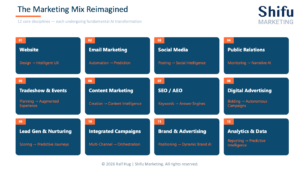
The overall pattern is consistent: marketing is shifting from a set of disconnected channel activities to an integrated, data-driven system. The implications run deeper than efficiency. They change the logic of how campaigns are built, how performance is measured, and how decisions get made.
The Changing Customer Journey
The traditional customer journey — Search → Website → Lead → Funnel → Conversion was never perfectly linear, but it was predictable enough to build planning models around. AI-driven discovery is breaking that predictability.
Customers increasingly encounter brands through AI assistants, algorithmic recommendation systems, social feeds, communities, and creator ecosystems — often long before they visit a company’s website. Marketing leaders increasingly talk about messy journeys rather than managed funnels. The implication is significant: marketing teams can no longer rely on a controlled funnel that begins with search traffic and ends with form fills. Instead, marketing must focus on influencing discovery ecosystems across multiple channels simultaneously — building brand presence in the spaces where AI systems, algorithms, and communities make recommendations.
Search Is Becoming Answer Engines
A second structural shift is happening within search itself. Traditional SEO focused on ranking pages and generating clicks. AI-driven search increasingly delivers answers rather than links. Large language models integrated into search interfaces summarize information directly, reducing click-through to individual websites — particularly for informational queries.
This shift toward answer-engine optimization (AEO) changes the calculus of content strategy. Visibility and authority matter more than raw traffic volume. Brands that produce original insights, credible expertise, and distinctive perspectives will benefit most from this change — while those that have relied on high-volume, undifferentiated content will find their organic reach eroding.
V. What AI Cannot Replace in Marketing
Understanding what AI does well is only half the analysis. The more strategically important question for marketing leaders is what AI does poorly — and how to ensure those capabilities remain at the core of the team.
Brand Positioning and the Big Idea
AI can imitate a brand voice with impressive accuracy once it has been trained on sufficient examples. What it cannot do is originate one. The positioning decision — what a company stands for, who it serves, what makes it different — still requires human judgment informed by cultural intelligence, market instinct, and creative conviction. The same applies to the creative breakthrough: the unexpected campaign concept that reframes how customers see a category is still a deeply human output. It emerges from experience, risk tolerance, and a willingness to make a bet that cannot be A/B tested into existence.
Cultural Intelligence
AI is trained on historical data. It reflects what has already worked, what has already resonated, what has already been said. Cultural relevance requires understanding what people care about right now — the ability to read a moment, interpret a shift in public sentiment, and respond authentically rather than algorithmically. Marketing leaders who can do this consistently still hold a decisive advantage over teams that outsource creative judgment to models.
Trust and Community
The most durable marketing advantage today is not reach. It is trust. Communities, relationships, and brand loyalty emerge from consistent human interaction — responding to criticism with integrity, recognizing loyal customers as individuals, showing up in the conversations that matter to an audience. AI can assist these interactions. It cannot replace the authenticity that makes them meaningful.
VI. The New Marketing Organization: The AI Operating Model
As AI capabilities expand, the architecture of marketing organizations is changing. The most effective marketing departments are beginning to resemble AI-enabled command centers rather than traditional creative teams. A useful framework for understanding this shift is the AI Marketing Operating Model — four interconnected layers that together describe how a modern marketing function runs.
|
Layer |
What It Does |
Human vs. AI |
|
① Strategy |
Brand positioning, segmentation, budget decisions, and campaign architecture. Sets the direction for the entire marketing system. |
Human-led. AI supports research and scenario modeling. |
|
② Orchestration |
Coordinates AI systems, marketing tools, and campaign workflows. The emerging ‘operating system’ of modern marketing — run by marketing technologists and AI Ops roles. |
Hybrid. Humans design and govern; AI executes at scale. |
|
③ Execution |
Content production, advertising, email, social media, and lead generation. AI accelerates output; humans provide creative direction and quality control. |
AI-augmented. Volume and speed from AI; voice and quality from humans. |
|
④ Intelligence |
Campaign analytics, behavioral pattern detection, predictive modeling, and real-time decision support. Replaces static monthly dashboards with live insight systems. |
AI-led. Humans interpret insights and act on them. |
The model has a clear logic. Strategy sets the direction — what the brand stands for, which segments to target, how budget should be allocated across channels. Orchestration is the emerging middle layer: the marketing technologists, RevOps leaders, and AI operations specialists who design and govern the systems that allow execution to scale. Execution is where AI augmentation is most visible — content at volume, personalized campaigns, automated email sequences — with humans providing direction and quality control. Intelligence is where AI provides the most transformative value: replacing static monthly dashboards with real-time analytical systems that surface patterns, forecast outcomes, and flag risks before they appear in the numbers.
The CMO who leads effectively in this model is not simply the chief creative champion. They are also the chief AI governance leader — responsible for vendor selection, data privacy strategy, responsible use policy, and the architectural decisions that determine how the four layers connect and how well they function as a system.
VII. The Real Risks Marketing Leaders Must Address
AI introduces significant opportunities — but also risks that require deliberate management. Three deserve particular attention from marketing leadership.
Brand dilution from generic AI content. When every brand in a category uses similar AI tools trained on the same internet data, outputs converge. Without strong editorial direction, AI-generated content becomes indistinguishable from competitors’. Paradoxically, AI makes distinctive brand voice more valuable, not less — because it is the one thing AI cannot replicate at scale.
AI misinformation in campaigns. AI models generate incorrect information with high confidence. Publishing unverified AI output — fabricated statistics, hallucinated citations, inaccurate product claims — creates reputational and legal exposure. Human editorial review is not optional in an AI-assisted marketing workflow. It is the single most important quality control mechanism in the entire production process.
Over-automation destroying trust. Hyper-personalization that is too accurate feels invasive. Automated communications that cannot escalate to a human feel dehumanizing. The most sophisticated marketing leaders deliberately design limits to automation — not because they have to, but because they understand that long-term trust is worth more than short-term conversion lift.
VIII. A Practical Roadmap for AI-Powered Marketing
For marketing leaders moving from experimentation to systematic AI integration, a phased approach reduces risk and builds organizational capability progressively.
Phase 1 (Months 1–3): Automate Repetitive Content Creation
The highest-value, lowest-risk starting point is using AI to accelerate content that is already templated or formula-driven: social post drafts, ad copy variations, email subject lines, and first-draft articles from existing briefs. The goal is not to reduce the team — it is to free marketers from repetitive execution so they can direct more energy toward strategy and quality control.
- Identify the content types produced most frequently and with the highest repetition
- Select one AI writing tool and train two or three team members as power users
- Establish an editorial review protocol before any AI-generated content is published
- Measure: time saved per piece, volume increase, quality score from internal review
Phase 2 (Months 4–6): Personalize at Scale
Once the team has operational confidence with AI-assisted content production, integrate AI-driven segmentation into email, paid media, and website workflows — predictive lead scoring, dynamic landing pages, and behavioral triggers. This phase improves relevance rather than simply volume.
- Audit CRM and marketing automation data quality — AI personalization is only as good as its underlying data
- Define what personalized messaging looks like for each high-value audience segment
- Implement one personalization use case at a time, measure its impact, then expand
- Measure: engagement rate by segment, conversion rate lift, pipeline contribution
Phase 3 (Months 7–12): Build a Predictive Marketing Strategy
The most mature phase involves AI informing strategic decisions: forecasting campaign outcomes before launch, attributing revenue influence accurately across channels, and surfacing the patterns in marketing data that would take weeks to find manually.
- Invest in data infrastructure — predictive analytics requires clean, integrated, and current data
- Define the strategic questions AI should answer: where budget is underperforming, which segments are growing, what drives pipeline
- Build a regular cadence for AI-generated insight reviews with marketing leadership
- Measure: forecast accuracy, budget efficiency, revenue influence per channel
IX. The Brands That Will Win
The marketing leaders thriving in this environment are not those experimenting with the most AI tools. They are the ones who have developed a clear philosophy for AI marketing strategy — and the discipline to execute it consistently.
They use AI to produce more, faster, at lower cost. But they reinvest the time and budget that automation frees up into the things AI cannot replicate: original research, distinctive brand storytelling, genuine community relationships, and the creative bets that define category leadership.
They are not automating their way to the middle. They are using automation to create space for excellence.
The question for your marketing function is no longer whether AI will reshape the industry. That shift is already underway. The real question is whether your organization will learn to orchestrate AI capabilities faster — and more intelligently — than your competitors.
The brands that win will combine AI efficiency with human creativity. The ones that lose will sacrifice one for the other.
Ready to build your AI marketing strategy? Book a Marketing AI Strategy Session with Shifu. We map your current marketing function against AI opportunity areas and deliver a clear 90-day action plan — just a clear roadmap for execution.