

AI Literacy, Overwhelm, and the Race No Company Can Sit Out
Most organisations still think AI is in its early-adopter phase. The more uncomfortable possibility is that society has already crossed into something larger: the early operating-system phase, where AI quietly becomes the layer everything else runs on.
And yet the gap between the headlines and the reality remains enormous. The numbers make it concrete. By early 2026, OpenAI reported that ChatGPT had reached roughly 900 million weekly users — but only around 50 million paying subscribers across all tiers, a conversion rate in the single digits. Most of the world’s AI use runs on free tiers. Millions discuss AI. Far fewer have changed how they actually work.
This is the quieter story behind the bubble question. The free-versus-paid split is not a billing detail — it is a capability divide. Frontier-grade models, higher usage limits, and the agentic features that genuinely compress hours of work mostly sit behind the paid tier. Casual exposure to a free chatbot and daily reliance on a paid, capable system are not the same activity, and the economic data shows how few people have actually crossed that line. The market is also less monolithic than the headlines suggest: by early-2026 measures, ChatGPT held roughly 60 percent of generative-AI traffic, with Gemini and Microsoft Copilot each in the mid-teens and Claude around 4–6 percent — the latter strongest in enterprise rather than consumer use. The point is not which tool wins. It is that real, frontier AI adoption remains a niche within a niche.
That gap is the subject of this article — and closing it has become a leadership priority, not an IT footnote.
| The AI Readiness Assessment from Shifu Marketing turns this overwhelm into a concrete, prioritised plan — diagnosing where an organisation actually stands and what to move on first. |
This Is One of the Strangest Moments in Technology
AI currently feels overhyped and underestimated at the same time. It is everywhere in conversation and barely adopted in practice. It is revolutionary in capability and immature in reliability. Almost no one feels fully caught up — and that includes the people who are supposed to be the experts.
Every industrial revolution reshaped how humans worked. The steam engine mechanised labour. Electricity transformed production. Computers digitised information. The internet connected the world. AI is different because it touches cognition itself — the reasoning, writing, analysis, planning, and decision support that knowledge work is built on.
And the pace of improvement is the part leaders consistently underestimate. A few years ago, AI produced awkward paragraphs and broken images. Today it drafts near-expert strategic analysis, ships production code, and runs multi-step workflows with growing autonomy. The curve is still steepening. This is no longer theoretical. It is operational.
Even the Experts Are Overwhelmed
One of the most persistent misconceptions is that the people working closest to AI have clarity. Most do not. Researchers, executives, developers, and consultants are all absorbing the same flood: new models, new interfaces, new benchmarks, new agent frameworks, new regulation debates — every week.
The market now changes faster than organisational learning cycles can absorb it. That produces a strange institutional mood: excitement and exhaustion at the same time. Many capable professionals quietly think, “I cannot keep up anymore.” That feeling is not a weakness. It is a rational response to a genuinely unprecedented rate of change.
The Real Divide Is No Longer Company vs. Company
The most consequential AI divide is often framed as AI companies versus non-AI companies. The sharper line runs somewhere else entirely: between AI-native workers and traditional workers.
A professional fluent in AI-assisted research, drafting, analysis, and workflow automation can now compress hours of work into minutes. Not because the tools are perfect — they are not — but because they dramatically reduce friction at every step. Research accelerates. Writing accelerates. Analysis accelerates. Iteration accelerates. And increasingly, so does decision-making.
This changes the economics of knowledge work itself. The uncomfortable part for leadership: most organisations are not structurally prepared for a productivity gap that runs through their own teams rather than between them and a competitor.
Corporate AI Literacy Is Still Surprisingly Weak
Despite the volume of attention, many companies remain at the policy-PDF stage of AI adoption. Employees receive compliance warnings, vague guidelines, disconnected pilots, and the occasional workshop — but very little operational transformation.
The result is predictable. Shadow AI spreads. Employees experiment privately because the official organisation moves too slowly. Leadership discusses AI strategy in the abstract while teams quietly solve it themselves. That produces governance risk, fragmented capability, uneven adoption, and a low background hum of organisational anxiety.
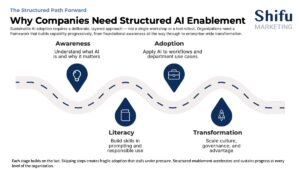
AI literacy is no longer optional technical knowledge. It is becoming a core business capability — the equivalent of spreadsheet literacy, internet literacy, and software literacy, except faster-moving and more disruptive. This is also where a structured method matters. A repeatable adoption pattern such as the 3P Model: Pain → Pilot → Proof — gives an organisation a way to convert scattered experimentation into deliberate, governed capability, rather than chasing every new tool.
Europe, China, and the US Are Taking Different Paths
The global AI race has also become a philosophical split. The United States prioritises speed, venture scaling, frontier-model competition, and ecosystem dominance. China prioritises strategic national acceleration, industrial deployment, and integration with manufacturing scale. Europe prioritises governance, regulation, privacy, and digital sovereignty.
Each approach carries a real risk. Europe risks moving too slowly. The US risks uncontrolled concentration and social disruption. China risks deeply centralised AI infrastructure. But one conclusion is increasingly hard to avoid: no one is opting out. AI has become too economically and geopolitically important for that to be a credible position.
“The Spirits That I Summoned”
Goethe may have written one of the better metaphors for the current moment. In Der Zauberlehrling — The Sorcerer’s Apprentice — the apprentice admits: “Die Geister, die ich rief, werd’ ich nun nicht los” — the spirits that I summoned, I now cannot get rid of.
That captures the institutional mood well. Organisations have set in motion systems that generate knowledge, automate workflows, and simulate reasoning at scale — and now face the harder questions. Who governs the acceleration? Who defines the boundaries? And, most practically: who remains economically relevant inside this new environment?
Past technological revolutions eventually stabilised. Factories normalised. Computers normalised. The internet normalised. AI may behave differently, because it improves continuously through human feedback, infrastructure scale, and recursive development. There may be no clean return to normal. This may simply become the operating environment.
The Optimists and the Pessimists Are Probably Both Wrong
The optimists can sound naive. The abundance argument assumes that AI compounds productivity, that gains distribute broadly, and that society adapts smoothly enough. History suggests transitions are rarely that painless.
But the pessimists are often wrong too. They tend to underestimate how effectively industries reconfigure and how quickly new economic layers appear. The internet destroyed some industries and created entirely new ones. AI will likely do the same — faster and at larger scale. The genuine problem is timing: society tends to adapt more slowly than the technology evolves, and that lag is where the instability lives.
What is striking is that the harder scenarios are no longer raised only by critics. In its April 2026 policy paper Industrial Policy for the Intelligence Age, OpenAI itself sets out the structural risks of the transition in plain terms: that large portions of cognitive work could become economically noncompetitive, that productivity gains may concentrate into capital ownership rather than spread broadly, and that a tax base built on wage and payroll income could erode as labour’s share of economic activity shrinks. OpenAI frames these as problems for policy to pre-empt, not as forecasts — but the signal for business leaders is the same either way. When the firms building the technology are already modelling a world in which wage-based work and wage-based taxation come under structural pressure, treating AI as a routine productivity upgrade is no longer a defensible planning assumption. The question shifts from whether to adopt AI to how to stay economically relevant inside the system it creates.
The fact that even the Pope is speaking publicly about AI shows how fundamental this shift has become. AI is no longer just a technology discussion — it is a leadership, workforce, and societal issue. Companies must accelerate AI literacy and adoption to remain competitive, while ensuring humans remain accountable for decisions, values, and trust.
So How Should Leaders Actually Respond?
The honest answer is that no organisation will ever fully catch up. The field moves too quickly for catching up to be a coherent goal. The realistic objective is continuous adaptation — and that is a structural choice, not a motivational one.
In practice, the organisations that adapt well tend to share a pattern:
- They experiment consistently rather than in occasional bursts, and treat experimentation as a standing process.
- They standardise selectively — keeping what works, retiring what does not, and writing the result down.
- They build AI literacy as ongoing capability development, not a one-off training event.
- They focus on operational use cases tied to real business pain, not on tool novelty.
- They invest in workflows and judgement, because tools change faster than the thinking behind them.
- They stop waiting for certainty — because certainty is unlikely to arrive.
The fears around AI are not all irrational. Labour displacement, concentration of power, misinformation, and dependency deserve serious attention, and some job categories will genuinely shrink while others transform. But pretending the shift is not happening is no longer a credible leadership position. The spirits have been called. The only real question is who learns to direct them.
Continuous adaptation starts with knowing where you stand. Book an AI Readiness Assessment from Shifu Marketing — and turn AI overwhelm into a prioritised plan. |
SOURCES
ChatGPT users & subscribers: OpenAI disclosures, early 2026 (~900M weekly active users; ~50M paying subscribers across all tiers; 9M+ paying business users). Reported via fatjoe.com / Second Talent, May 2026.
Free-vs-paid conversion: Similarweb-based analysis indicating ~5% of ChatGPT users on paid tiers (Jan 2026).
Generative-AI market share: First Page Sage, April 2026 (ChatGPT 60.4% · Gemini 15.2% · Copilot 14.4% · Claude 4.2% · Perplexity 2.8%). Web-traffic measures differ by provider — figures cited as ranges.
Daily-use benchmark: Gallup Workforce survey, Q3 2025 (daily AI use ~10% of US workforce).
Vatican News official statements on AI ethics and human dignity: ENCYCLICAL LETTER
MAGNIFICA HUMANITAS OF HIS HOLINESS POPE LEO XIV ON SAFEGUARDING THE HUMAN PERSON IN THE TIME OF ARTIFICIAL INTELLIGENCE