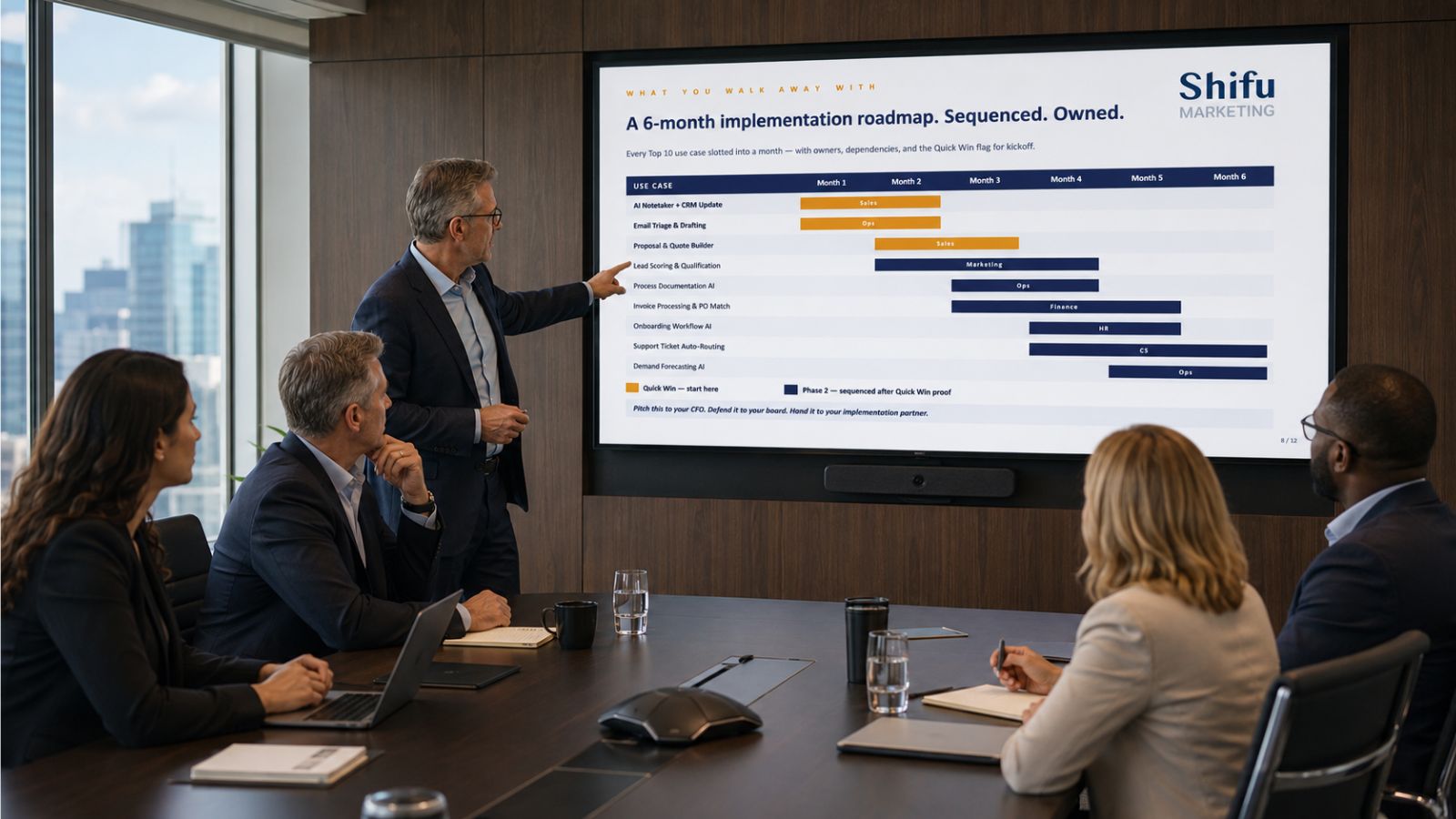
| Book an AI Readiness Assessment — 60 minutes to turn your AI backlog into a sequenced, ROI-ranked roadmap. |
Right now, almost every leadership team is having the same conversation. The CEO asks what the AI strategy is, and the organisation responds with a burst of activity: departments brainstorm use cases, vendors pitch copilots, employees experiment privately, and a taskforce is assembled. Six months later, very little has changed operationally. There is no roadmap, no ROI visibility, no management alignment, and no prioritised sequence — just another innovation initiative stranded between hype and uncertainty. This is becoming one of the defining AI problems inside companies today. The issue is not a shortage of ideas. It is a shortage of operational clarity.
Most Companies Already Have 100 AI Ideas
Generating ideas stopped being the hard part. AI now touches sales, marketing, operations, HR, finance, customer service, product, engineering, procurement — and management itself — at the same time. Every function can imagine a use case. What most organisations still lack is a structured way to answer the harder questions: which use cases matter most, which are realistic, which generate measurable ROI, which require change management, which need better data first, and which should start now versus wait.
Without that structure, companies drift toward one of two extremes: random experimentation or total paralysis. Neither produces competitive advantage. The result is an “AI backlog” inside the business — a growing pile of ideas, subscriptions, disconnected pilots, and unvalidated assumptions with no strategic orchestration.
AI Is No Longer a Side Project
Many organisations still underestimate the nature of the shift. AI is not becoming another software category that can be adopted department by department — a CRM for sales here, an ERP for finance there. AI behaves as a horizontal operational layer. It touches workflows, communication, decisions, knowledge work, planning, reporting, and customer interactions simultaneously. That is why AI transformation is increasingly organisational, cultural, operational, and strategic — not merely technical. The stakes change accordingly.
The Real Gap Is Readiness, Not Technology
Most companies are not blocked by model quality, tooling availability, or innovation speed. The tools already exist. What organisations actually struggle with is process clarity, leadership alignment, AI literacy, ownership, prioritisation, governance, and change capacity. The technology moves faster than the organisation — which is why so many initiatives stall before production.
This is also where most leadership teams misjudge their own position. They tend to overestimate adoption, literacy, process maturity, and integration capability. Meanwhile employees experiment privately while official adoption stays minimal. The company looks “AI active” externally while internally workflows remain unchanged, operational leverage stays low, and ROI stays invisible. An honest AI maturity assessment is not a consulting exercise — it is the strategic baseline without which any roadmap becomes guesswork.
The Best AI Use Cases Start with Pain
The strongest AI initiatives rarely begin with “where can we use AI?” They begin with “where is the organisation losing time, money, speed, or visibility?” That is the logic behind the 3P Model, the AI adoption framework developed by Shifu Marketing, which sequences every initiative through three stages: Pain, Pilot, and Proof.
Pain comes first — a specific, measurable operational problem worth solving. Pilot is a contained, low-risk implementation against that problem. Proof is the documented business outcome that justifies scaling. The strongest starting points are usually unglamorous: repetitive workflows, reporting bottlenecks, manual coordination, CRM hygiene, proposal generation, customer support, process documentation, and forecasting. The quick wins are modest — but they build trust, and trust compounds.
ROI Is Becoming the New AI Battleground
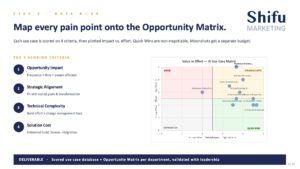
The first AI wave was driven by curiosity. The next will be driven by economics. Boards increasingly ask what the ROI is, where the savings are, which workflows improve, how many hours are reduced, and what changes operationally. Transformation without prioritisation simply becomes expensive experimentation. The strongest organisations now map AI initiatives against four variables — opportunity impact, strategic alignment, technical complexity, and implementation cost — which produces what most companies currently lack: a roadmap leadership can defend.
AI-Native Competitors Are Reshaping the Economics
A widening gap is emerging between incumbent organisations and AI-native companies. AI-native organisations build differently from day one: automation first, AI-assisted workflows, lean teams, agentic systems, and continuous optimisation. That creates a different cost structure, a different speed of execution, and a different scalability model. Incumbents often still run on manual coordination, fragmented systems, reporting lag, and organisational silos. The risk is not that incumbents disappear overnight — it is that AI-native competitors operate with smaller teams, faster iteration, and higher leverage per employee. That pressure is already reshaping industries.
AI Transformation Is Also Change Management
This is where many AI projects fail. Leadership assumes adoption is mainly technical implementation when it is, in practice, behavioural transformation. Employees need clarity, training, trust, governance, practical workflows, and visible leadership direction. Without it, adoption fragments: some employees become highly AI-native while others disengage, creating capability inequality inside the organisation itself. Employees are already asking whether AI will replace parts of their role, which skills still matter, and which tools are approved. Ignoring those questions creates resistance; addressing them creates transformation capacity.
The Real Advantage Is Organisational Adaptation
The future winners may not be the companies with the best AI tools. They are more likely to be the organisations that adapt fastest, align leadership quickest, operationalise AI responsibly, train employees continuously, and integrate AI closest to the workflows that matter. Waiting for perfect certainty — stable tooling, complete regulatory clarity, fully mature standards — is itself a strategic mistake, because AI-native competitors keep learning while incumbents wait. The first roadmap does not need to be perfect; organisational learning is the compounding asset.
In short, AI transformation is not about installing software. It is about redesigning how the organisation operates — with vision, sequencing, governance, leadership alignment, and measurable outcomes. Competitive advantage rarely comes from accessing technology first. It comes from integrating it into the business better than everyone else. That is the difference between AI experimentation and AI transformation: the companies that succeed will not be the loudest, but the ones that systematically turn AI potential into operational capability.
Book an AI Readiness Assessment — 60 minutes to turn your AI backlog into a sequenced, ROI-ranked roadmap your management team will sign.