


I. The Sales Performance Gap Is Widening
Sales has always been a performance-driven profession. Top performers close more deals, build stronger relationships, and generate more revenue than the rest of the team. That dynamic has not changed.
What has changed is the speed at which the gap between top performers and average performers is widening.
Artificial intelligence is not replacing salespeople. But it is dramatically amplifying the capabilities of those who know how to use it.
Early data from AI-assisted sales teams shows three consistent effects:
- Sales reps spend significantly less time on administrative work
- Pipeline quality improves due to better prospect prioritization
- Forecast accuracy increases through predictive analytics
The result is simple: the best reps close more deals because they spend more time selling.
For sales leaders, this creates a strategic challenge. Your top performers are already experimenting with AI tools on their own. Your middle performers may be unsure how to use them. And the bottom of your team may be doing work that AI can already automate.
The question is no longer whether AI will affect your sales organization. The question is whether your team will adopt it fast enough to remain competitive.
II. Where AI Is Transforming the Sales Workflow
AI is not changing sales in one place. It is reshaping the core workflows that drive revenue.
Across modern B2B organizations, eight workflows are emerging where AI delivers measurable value.
- Lead Generation
AI identifies high-potential prospects based on firmographic data, intent signals, and historical conversion patterns. Instead of manually building prospect lists, sales teams can prioritize companies statistically more likely to convert.
- Sales Intelligence
AI tools analyze customer data, market signals, and previous deal patterns. Reps gain a clearer picture of buying signals, competitive risks, and potential deal blockers — reducing guesswork in complex sales cycles.
- Engagement and Outreach
Personalized outreach once required extensive research and manual writing. AI now enables teams to generate highly tailored messages at scale using CRM data, LinkedIn activity, company news, and industry signals.
- Meeting Intelligence
Conversation intelligence platforms analyze sales calls and detect objection patterns, competitor mentions, engagement signals, and stakeholder involvement. Managers can coach based on real conversations rather than anecdotal feedback.
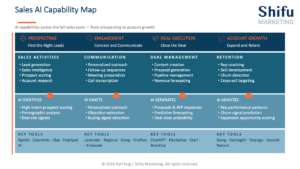
- Content Creation
AI generates structured first drafts of proposals, presentations, RFP responses, and business cases in minutes — dramatically reducing preparation time.
- CRM Automation
Modern AI systems automatically capture meeting notes, summarize calls, and update CRM fields without manual input. For many teams, this alone saves several hours per rep per week.
- Pipeline and Forecasting
AI-driven forecasting analyzes historical deal data, pipeline behavior, and engagement signals. Organizations gain predictive insight into which deals are most likely to close rather than relying solely on rep intuition.
- Customer Expansion
AI identifies upsell and cross-sell opportunities within existing accounts. Signals such as product usage patterns, company growth, and buying behavior help account managers prioritize expansion opportunities.
III. AI Productivity: Good → Better → Best
AI adoption in sales does not require a full technology overhaul. Most organizations improve in stages — starting with individual productivity wins and progressing toward a coordinated revenue architecture.
The framework below maps that progression. Each level is achievable independently. Most organizations start at Good and expand from there.
| Good | Better | Best |
Immediate adoption Tools reps use tomorrow: · Meeting summaries · AI email drafting · Call transcription · CRM auto-notes 2–3 hours saved per rep/week | Team-level workflow AI-assisted processes: · Lead research · Call analysis · Follow-up automation · Proposal generation 20–30% productivity gain | Revenue architecture AI at the system level: · Predictive lead scoring · Pipeline risk detection · AI forecasting · Account intelligence Revenue engine optimization |
The most important principle: start where adoption is easiest. A single rep saving two hours a week demonstrates value faster than a six-month platform implementation.
IV. A Realistic Example: AI Adoption in a European Sales Team
Consider a mid-sized European industrial technology company with a 25-person sales organization selling complex B2B solutions.
Before adopting AI tools, their teams struggled with familiar problems: heavy CRM administration, inconsistent pipeline visibility, slow proposal creation, and limited insight into deal risks.
The company implemented three AI capabilities:
- Meeting transcription and automatic CRM updates
- AI-assisted proposal drafting
- Predictive pipeline analytics integrated into their CRM
Within six months, measurable improvements appeared:
- Selling time per rep increased from 34% to 51%
- Proposal preparation time dropped by 60%
- Forecast accuracy improved significantly
The company did not reduce headcount. Instead, the team effectively gained the equivalent productivity of five additional salespeople without hiring anyone.
This is the real impact of AI in sales: time returned to selling.
V. The Modern AI Sales Technology Stack
AI capabilities rarely exist in isolation. They operate inside a broader sales technology ecosystem.
Most AI-enabled sales organizations combine several core layers.
CRM Systems
Salesforce · HubSpot · Microsoft Dynamics — these platforms serve as the system of record for customer data.
Conversation Intelligence
Gong · Fireflies · Kickscale · Microsoft Copilot — these tools analyze meetings and extract insights from conversations.
Sales Engagement Platforms
Outreach · Apollo · Salesloft — these systems enable AI-assisted outreach and pipeline management.
Forecasting and Revenue Analytics
Clari · BoostUp · Microsoft Copilot — these tools provide predictive pipeline insight and deal risk signals.
Enterprise Ecosystem: Microsoft vs Google
For European organizations, the choice of productivity platform shapes which AI tools integrate most naturally.
Microsoft-first organizations benefit from Copilot embedded directly into Outlook, Teams, Dynamics, and Excel. Sales teams can generate proposals, capture meetings, update CRM, and run pipeline reports entirely inside the existing workflow — reducing tool fatigue and simplifying compliance.
Google Workspace organizations, more common in startups and collaboration-heavy teams, leverage Gemini across Meet, Docs, and Gmail. AI content workflows and meeting automation are strong, though enterprise CRM integration typically requires additional configuration.
Neither ecosystem is inherently superior. The decision depends on existing tooling — and changing it mid-adoption is costly. Work with the ecosystem your team already uses.
The goal is not to accumulate tools. The goal is to build a coherent workflow where AI reduces friction rather than adding complexity.
VI. Hunter vs Farmer: AI Affects Them Differently
Most sales organizations divide their teams between hunters — reps focused on new business — and farmers, who manage and grow existing accounts.
AI affects these two roles in fundamentally different ways. Treating them the same in an AI adoption plan is a common mistake.
| Hunters — New Business | Farmers — Account Management |
AI advantages: · Lead scoring & intent signals · Prospect research at scale · Personalised outreach · Competitive intelligence Goal: pipeline velocity | AI advantages: · Account health scoring · Expansion & upsell signals · Renewal risk detection · Customer usage analytics Goal: revenue expansion |
For hunters, AI compresses the front end of the pipeline — prospecting, research, and outreach — so more time goes to qualified conversations.For farmers, AI surfaces the signals that matter most: which accounts are at risk, which are ready to expand, and which are quietly disengaging. Revenue retention and growth depend on acting on those signals early.
Sales leaders building AI adoption plans should design separate workflows for each role. The tools may overlap. The priorities do not.
VII. AI in Sales Under European Regulations
For European companies, AI adoption in sales also requires attention to data protection and regulatory compliance.
Many AI sales tools analyze customer interactions, meeting recordings, and CRM data. This raises several considerations under GDPR and emerging EU AI regulations.
Sales organizations must evaluate:
- Whether meeting recordings require explicit customer consent
- Where conversation data is stored and processed
- Whether AI tools train models on customer data
- How long sales interaction data is retained
Many companies therefore prioritize tools that support EU data hosting, enterprise privacy controls, and clear data processing agreements.
Platforms integrated into existing enterprise environments — such as Microsoft’s Copilot ecosystem — are often adopted faster because they align with existing compliance frameworks.
AI adoption in Europe requires balancing innovation with responsible data governance.
VIII. The Skills That Remain Irreplaceably Human
Despite advances in AI, the core drivers of successful sales remain deeply human.
Trust and Relationship Building
Enterprise buyers still choose vendors they trust. That trust develops through consistent communication, reliability, and long-term relationship building. AI can support this process but cannot replace it.
Complex Negotiation
Large deals involve multiple stakeholders, procurement processes, and strategic trade-offs. Negotiating these dynamics requires experience and judgment that no AI model can replicate.
Champion Development
In complex B2B sales, internal champions often determine whether deals succeed. Helping those champions navigate internal decision processes remains a uniquely human skill.
IX. The AI Sales Maturity Curve
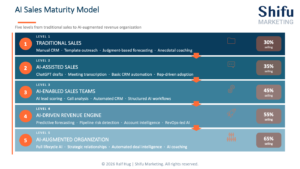
Not every sales organization adopts AI at the same pace. Most companies move through several stages of AI maturity.
Level 1 — Traditional Sales
Minimal AI usage. CRM used primarily for reporting.
Level 2 — AI-Assisted Sales
Individual reps use AI tools for emails, notes, and research.
Level 3 — AI-Enabled Sales Teams
AI integrated into workflows such as lead scoring, call analysis, and CRM automation.
Level 4 — AI-Driven Revenue Engine
Predictive forecasting, deal risk detection, and RevOps-driven analytics guide sales strategy.
Level 5 — AI-Augmented Sales Organization
AI handles administrative and analytical tasks while human sellers focus almost entirely on strategic selling.
Many organizations today operate between Level 2 and Level 3. The companies moving toward Levels 4 and 5 are beginning to see meaningful productivity advantages.
X. The Real Barrier: Adoption
The biggest obstacle to AI adoption in sales is rarely technology.
It is behavior change.
Sales professionals are often skeptical of new tools, especially if those tools increase administrative work. Successful AI adoption follows three principles.
Remove Work, Do Not Add It
AI tools must eliminate tasks such as manual note taking, CRM updates, and research preparation. If a tool adds steps, adoption collapses.
Start with Top Performers
The most effective approach is to identify early adopters among top-performing reps and let them demonstrate successful workflows. Salespeople trust proven results more than corporate mandates.
Embed AI in Existing Tools
AI adoption is far easier when it integrates into tools already used daily — email platforms, CRM systems, meeting software. The fewer new interfaces introduced, the higher the adoption rate.
XI. The AI-Augmented Sales Organization
The most successful sales organizations in the coming years will not be automated. They will be human–AI hybrid systems.
AI will handle tasks where speed and data processing matter most: research, reporting, forecasting, CRM maintenance.
Human sellers will focus on the moments where judgment and relationships are essential: strategic conversations, negotiation, trust building, account growth.
In many traditional organizations, sales reps spend less than one-third of their time actually selling. AI-enabled teams are already pushing that number significantly higher.
This does not just increase productivity. It changes the structure of sales itself.
XII. The Strategic Question for Sales Leaders
The transition to AI-enabled sales is already underway.
The question is not whether AI will influence your sales organization. It is how quickly your team adapts its operating model.
Sales leaders who move early gain several advantages:
- Higher productivity per sales rep
- Stronger pipeline quality
- More accurate forecasts
- Greater competitive resilience
The sales organizations that thrive will not be those that replace human sellers with AI.
They will be the ones that give their sellers an AI advantage.
If you want to understand where your sales organization stands, consider conducting an AI Sales Readiness Assessment.
Shifu benchmarks your sales workflows against leading AI-enabled teams and identifies practical opportunities to improve productivity, forecasting accuracy, and pipeline performance.
Practical. Independent. No vendor agenda.