


I. Is AI Replacing the Product Manager?
The product manager role is not disappearing. The work that defined it for the last twenty years is.
Writing user stories, synthesizing research, maintaining backlogs, generating first-draft specs — these tasks consumed the majority of most PMs’ working weeks. They required skill, discipline, and coordination. They also required time that AI tools can now compress by 60 to 80 percent in production environments where teams have built the workflow.
That compression does not make product managers less necessary. It makes the question of what they are necessary for more urgent than it has ever been.
The answer — in the organizations getting this right — is judgment. The PM who can make the right product bet under uncertainty, align a cross-functional team around it, and shape how an intelligent system behaves once it ships is more valuable today than they were three years ago. The PM who contributes primarily at the execution layer is in a different situation entirely.
Execution is becoming cheaper. Strategic judgment is becoming more valuable. The PMs who thrive in the next decade will not be defined by how many tickets they manage. They will be defined by the quality of the product bets they help the organization make.
Download the AI Workflow Assessment for Product Teams — map your team’s AI readiness across discovery, delivery, and growth.
II. AI Across the Product Lifecycle
To understand how AI is reshaping product management and AI in practice, it helps to view the product lifecycle in three stages: Discovery, Delivery, and Growth. Each stage is changing in different ways.
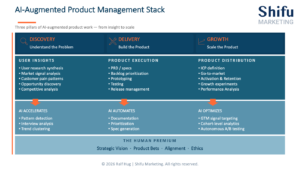
Product Discovery: AI Accelerates Insight
Product discovery has traditionally been slow and labor-intensive. Teams conduct user interviews, analyze support tickets, review customer feedback, and synthesize insights across many signals. A full discovery cycle could easily consume weeks.
AI compresses this process dramatically. Modern tools can analyze thousands of support tickets, product reviews, interview transcripts, behavioral analytics, and usage logs from connected products. They cluster patterns, surface emerging problems, and identify recurring customer needs.
The implication is not that AI replaces discovery. It shifts the bottleneck. The PM’s job becomes less about gathering signals and more about interpreting them — deciding which patterns matter, which signals represent noise, and which problems are strategically meaningful. Discovery becomes faster. Judgment becomes more valuable.
Product Delivery: AI Automates Execution
The most visible impact of AI appears in product delivery. Given a well-defined product brief, modern AI tools can generate product requirements documents, user stories and acceptance criteria, test scenarios, documentation, and release notes. These outputs are often good enough to serve as a starting point for real work.
But they reflect the quality of the input. If the brief is vague, the resulting specification will simply be a longer version of that vagueness. If the assumptions are flawed, the AI will formalize those flaws efficiently. AI is doing the writing. The thinking still belongs to the PM and the team.
The role of product management therefore shifts from document production to problem definition and clarity.
Product Growth: AI Reshapes How Products Reach the Market
The growth stage of the product lifecycle is where AI’s impact is most commercially significant — and most underestimated. The traditional PM handed off to marketing once a feature shipped. In AI-augmented product organizations, the PM is increasingly involved in shaping how the product grows, because the tools that drive distribution are generating product signals that belong in the roadmap.
AI is transforming go-to-market execution at the signal layer. Ideal customer profile definition, which once relied on periodic analysis of closed-won deals, can now be continuously refined using AI-driven cohort analysis across behavioral, firmographic, and usage data. PMs who understand this output can make better sequencing decisions about which customer segments to prioritize in the next development cycle — not just which features to build.
Activation and retention — the gap between a customer who signed up and a customer who gets value — is increasingly an AI optimization problem. Cohort-level analytics can surface the specific behaviors that predict long-term retention versus early churn, often at a granularity that manual analysis could never reach within a planning cycle. This is product information. The PM who reads it can design onboarding flows, feature defaults, and in-product guidance that close the activation gap before it becomes a commercial problem.
Performance analysis is also changing. Autonomous A/B testing platforms can now run more experiments in parallel, with tighter statistical controls, than any human-managed experimentation program could sustain. But faster testing creates a new constraint that is easy to miss: the bottleneck shifts from executing tests to generating the right hypotheses. AI can tell you which variant won. It cannot tell you which question was worth asking. That judgment — connecting a growth signal to a product insight worth acting on — remains the PM’s contribution.
The implication for product leadership is structural. The PM of 2026 sits closer to the commercial function than the PM of 2020 did. Not because product and marketing have merged, but because AI has made the boundary between product decisions and go-to-market decisions more permeable — and the best product organizations are deliberately building across it.
III. The Rise of AI-Native Product Development
A quieter shift is transforming how products are created. For decades, the standard workflow followed a familiar pattern: PM defines requirements → Design defines interface → Engineering writes code → Physical or digital product is built and tested. AI is beginning to collapse parts of this chain — though what that collapse looks like depends heavily on the type of product being built.
In software-led organizations, the change is most visible in prototyping speed. In industrial and hardware environments, it shows up differently — in simulation fidelity, digital twin capability, and the speed at which product teams can analyze data from deployed systems in the field. Both paths are significant. Both are moving faster than most product organizations have acknowledged internally.
The software path: from specification to working prototype in hours
A B2B SaaS product team working on a new customer notification feature would historically spend two to three weeks in the requirements-and-design phase before any working software existed. A product manager would write the spec, the designer would produce mockups, those mockups would go through review cycles, and engineering would eventually produce a prototype. Total time from idea to something a customer could click through: three to four weeks on a tight timeline.
The same team, using Cursor — an AI-native code editor that generates working software from natural language instructions — with a well-briefed PM, can now produce a functional UI prototype — real screens, real interactions, connected to a test data layer — in a day. Not a mockup. Not a Figma frame. Something a customer can actually use, break, and give feedback on. The prototype is not production-ready, and engineering still owns the system that ships. But the feedback loop from concept to customer insight has compressed from weeks to days.
The hardware path: AI compresses validation, not just documentation
For product managers in industrial companies — manufacturing equipment, medical devices, automotive platforms, connected machines — the equivalent shift is happening at the validation layer rather than the prototyping layer. AI cannot accelerate the physical build cycle or replace certification processes. What it can do is dramatically improve the quality and speed of decisions made before those cycles begin.
AI-driven simulation tools allow product teams to test more system configurations, failure modes, and edge cases before committing hardware to a build. Digital twins trained on sensor data from deployed machines let PMs understand how customers actually use existing products — not how they were designed to be used. That gap between designed behavior and real behavior is where most industrial product decisions have historically been made blind. AI makes it visible.
In both contexts — software and hardware — the underlying shift is the same. Teams that build AI-augmented validation workflows learn faster than teams that remain document-driven. For industrial PMs in particular, AI becomes the bridge between physical products and digital intelligence — the connective layer that makes field data actionable inside the product development cycle. The PM’s role in either model changes accordingly: less primary author of the specification, more the person with enough product clarity to brief the AI effectively, enough judgment to evaluate what it produces, and enough customer knowledge to know whether what they just built or simulated answers the right question.
IV. When Engineering and Product Begin to Converge
For decades, product management and engineering operated as distinct disciplines with a clear handoff between them. The PM owned the what — the problem to solve, the user need, the business case. Engineering owned the how — the architecture, the code, the system that shipped. That boundary was not just organizational. It reflected a genuine difference in capability. Most PMs could not build software. Most engineers did not run customer discovery.
AI is eroding that boundary in both directions simultaneously.
Engineers moving into product territory
When an engineer can use Cursor or GitHub Copilot to generate a working prototype from a rough brief in hours, they no longer need a fully formed specification before they can engage with a product question. A senior engineer at a SaaS company who wants to explore a new onboarding flow can now scaffold a working version of it — real screens, real logic — before the PM has finished writing the user stories. That prototype becomes the conversation. The engineer is not replacing the PM, but they are participating in product discovery in a way that was practically impossible when prototyping took weeks rather than hours.
PMs moving into engineering territory
A technically fluent PM using the same tools can now produce a working prototype without writing a line of code — describing what they want in plain language and iterating on the output. They can interrogate a database directly to validate a hypothesis rather than waiting for an analyst. They can generate a first-draft data model or API structure to frame a conversation with engineering, rather than handing over a requirements document and hoping the intent survives translation. The PM is not becoming an engineer. But the gap between their world and engineering’s world is narrower than it has ever been.
The practical result is that the clearest point of authority in a product team — the PM owns requirements, engineering owns implementation — is becoming less fixed. In some AI-native startups, engineers now run the first round of user validation on prototypes they built themselves. In others, PMs arrive at sprint planning with working demos rather than documents. Neither model eliminates the need for both roles. But the value each role provides is increasingly about judgment and domain knowledge, not about exclusive control of a particular artifact.
For product leaders in Europe — where engineering culture is strong and PMs have historically had to earn their seat at the table by demonstrating technical credibility — this is worth paying attention to. AI does not make technical credibility less important for PMs. It raises the floor for what technical credibility means.
V. When Products Become Adaptive Systems
A deeper shift sits beneath all these workflow changes. The nature of products themselves is evolving.
Traditional software products were deterministic systems. Engineers wrote rules, and the software behaved according to those rules. Product management was largely about deciding which features to build.
AI-native products behave differently. They are adaptive systems. A recommendation engine improves as it observes user behavior. A copilot adapts based on user prompts. An AI assistant refines responses through feedback loops. These systems evolve over time.
In this environment, the PM is not only managing features. They are shaping system behavior. Key product decisions increasingly include:
- What signals the system should learn from
- How uncertainty should be handled
- When AI should defer to human control
- What guardrails ensure responsible and safe outcomes
These are not traditional feature decisions. They are system design decisions. The PM becomes responsible not just for what the product does today, but for how it learns and evolves over time.
VI. The New Product Manager Skill Set
The PM of 2026 is not the PM of 2020. The role remains essential — but the skills that define high performance are shifting in measurable ways.
AI Workflow Fluency
PMs must understand how to integrate AI into everyday product work — generating useful outputs, refining them, and building repeatable workflows across discovery, delivery, and growth. The PM who orchestrates AI effectively produces better results faster and with less operational drag.
AI Literacy
Product leaders must understand how AI systems work at a conceptual level, including model limitations, hallucination risks, training data implications, and evaluation methods. Without this literacy, AI decisions become vendor-driven rather than product-driven. The PM who cannot evaluate an AI vendor’s claims is not equipped to make the product architecture decisions that follow from those claims.
Data Fluency
PMs who can interrogate data directly — who can validate hypotheses without waiting for an analyst to build a dashboard — operate at a different speed than those who cannot. Data fluency does not require a data science background. It requires the ability to ask precise questions of quantitative information and to challenge weak insights with the right skepticism.
Change Leadership
Introducing AI into product workflows creates real disruption. Designers, engineers, analysts, and product leaders must adapt to new tools and new processes. The PM often becomes the person responsible for guiding that transition — building psychological safety, communicating the rationale for change, and managing the resistance that comes with any meaningful shift in how a team works.
VII. Product Leadership as Orchestration
In many organizations — particularly in Europe and industrial sectors — product management does not operate as a single point of authority over the product. Product decisions often involve engineering leadership, commercial teams, executive management, and regulatory stakeholders.
The PM therefore acts less as a ‘CEO of the product’ and more as the orchestrator of product direction. AI does not change this reality. If anything, it makes orchestration more important. AI can generate insights and accelerate execution, but organizations still need a leader who can translate those insights into shared direction across technical, commercial, and operational teams.
The PM becomes the integrator of perspectives rather than the sole owner of decisions. This requires a different kind of authority — one built on trust, clarity of reasoning, and the ability to hold a coherent product direction in the face of competing organizational pressures.
VIII. What This Means for Product Organizations
These shifts have structural implications for how product teams are built and managed.
Fewer Junior Execution Roles
Historically, junior PMs learned the craft through execution tasks — writing user stories, managing backlogs, running sprint ceremonies. AI is compressing that apprenticeship layer. Organizations increasingly expect PMs to demonstrate strategic thinking earlier in their careers, which raises the barrier to entry but also accelerates the development arc of PMs who adapt quickly.
The Rise of the AI Product Lead
A new hybrid role is emerging at the intersection of product strategy, data literacy, and understanding of AI systems: the AI Product Lead. These leaders translate AI capabilities into product opportunities, evaluate AI systems critically, and define the guardrails that govern how AI features behave in production. As companies build more AI-native products, this role is becoming one of the most in-demand in the market.
Smaller, More Strategic Teams
AI reduces the operational overhead required to build and operate products. Many organizations are experimenting with smaller product teams carrying higher expectations per person — fewer people doing more, at a higher level of strategic contribution. This trend rewards generalists with strong judgment and penalizes specialists whose value was primarily in execution volume.
IX. Action Steps for Product Leaders
Organizations integrating AI into product workflows are already seeing improvements in speed and productivity. Three steps accelerate the transition for teams that have not yet started.
1. Audit Product Workflows for AI Opportunity
Map where your product team spends its time. Identify the activities that are primarily execution — documentation, research synthesis, experiment analysis, backlog scoring — and evaluate where AI can augment those activities without sacrificing quality. Be honest about where the current process is slower than it needs to be.
2. Pilot AI Tools Systematically
The specific tools matter less than the problems you point them at — and the landscape shifts fast enough that any list published today is partially outdated within a quarter. What is more useful is understanding the capability categories already mature enough to put into a product team’s workflow.
- AI assistants for research and synthesis: Claude, ChatGPT, Gemini, and Perplexity can compress hours of market research, competitive analysis, and interview synthesis into minutes. No single assistant has a durable lead; the practical question is which one your team has built a consistent workflow around. Anthropic’s Claude family extends into Claude Code for AI-native software development and Claude Cowork for desktop task automation — worth noting for teams exploring how far a single AI ecosystem can reach across product workflows.
- Meeting and conversation intelligence: Tools like Fireflies, Otter, and Notion AI eliminate the manual note-taking and synthesis step from discovery interviews and cross-functional reviews.
- AI-native development environments: Cursor and GitHub Copilot shift how prototyping works, with direct implications for PM-engineering collaboration covered in Section III.
- Workflow automation and agentic systems: Platforms like n8n connect tools into automated pipelines. Beyond simple automation, agentic AI systems that plan and execute multi-step tasks autonomously are beginning to appear in product workflows. These are coordination layers, not point tools — and understanding how to design and govern them is becoming a core PM capability.
- Embedded AI in your existing stack: Microsoft Copilot, Jira AI, Confluence AI, and Salesforce Einstein mean AI adoption is increasingly about activating what is already in your tools, not adding new ones.
3. Redefine PM Success Metrics
If PM success is measured primarily by backlog management and feature velocity, the framework is measuring the wrong things. In an AI-augmented environment, the PM’s value lies in product judgment, the quality of strategic bets, cross-functional alignment, and user outcomes. Rebuild performance frameworks around what matters — and retire the metrics that reward execution volume over strategic contribution.
X. The PM Who Thrives
The product managers who thrive in the next decade will not be the ones most resistant to AI. Nor will they be the ones who blindly automate everything without applying judgment to the output.
They will be the ones who understand clearly what they contribute that AI cannot. Strategic judgment. Deep understanding of users. The ability to align diverse teams around a shared direction. The responsibility to shape how intelligent systems behave in the world.
Execution is becoming easier. Vision is becoming rarer. The PM who consistently demonstrates sound product judgment is not competing with AI — they are operating at the level that AI makes more necessary, not less.
The best product managers of the next decade will not be defined by what they ship. They will be defined by the bets they make, the alignment they build, and the judgment they bring to decisions that AI cannot make for them.
Conduct an AI Workflow Assessment for Product Teams — a practical framework that maps your current product activities against AI opportunity areas and identifies your highest-priority capability gaps.